Now Reading: Turning Down the Temperature: A Governance Plan for a Polarized Pakistan
-
01
Turning Down the Temperature: A Governance Plan for a Polarized Pakistan
Turning Down the Temperature: A Governance Plan for a Polarized Pakistan

Introduction
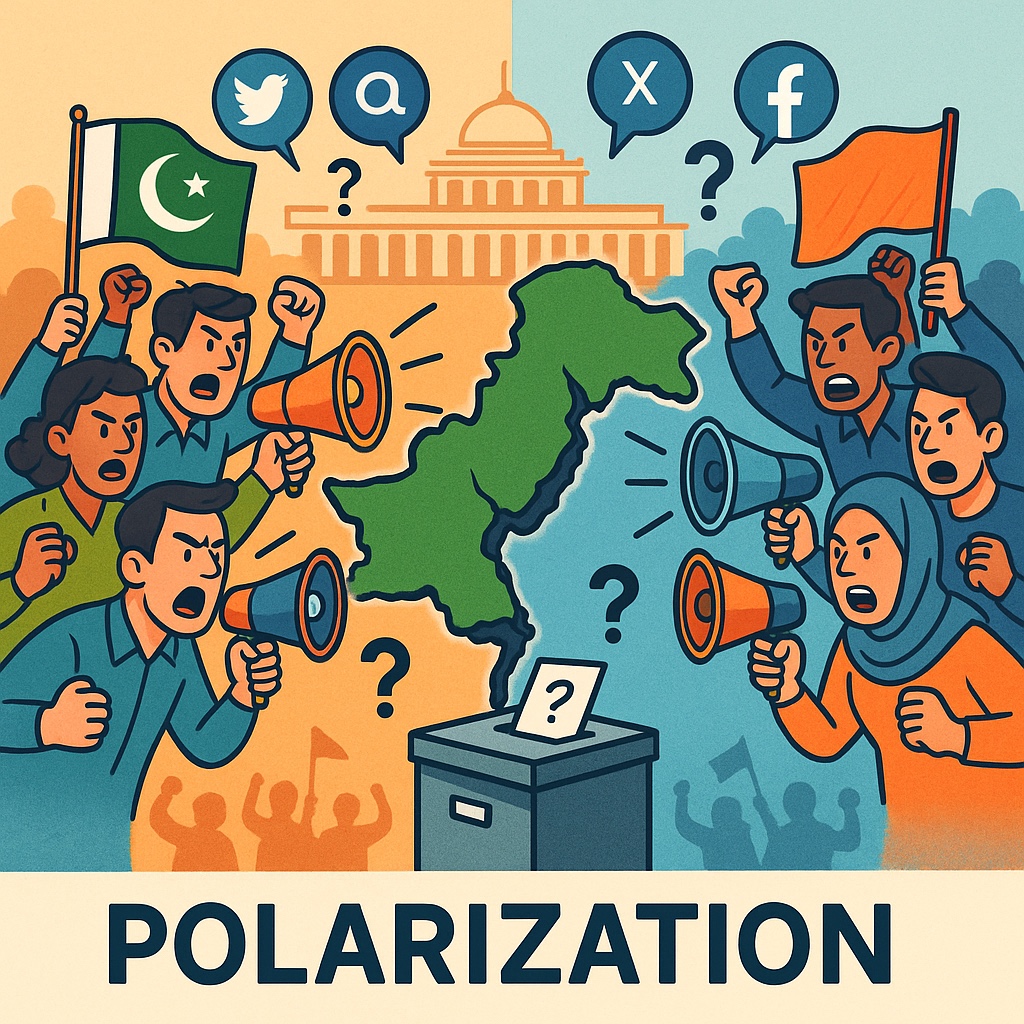
Ever since the general elections in February 2024, political polarization in Pakistan has been growing stronger. Making it more difficult to find a common ground and undermines the trust in the government institutions. According to independent reports, Pakistan is doing poorly in such aspects as fair elections, freedom of expression, and government operation. Freedom House gives Pakistan a rating of 32 out of 100, which is Partly Free, due to censorship of the 2024 elections and censorship of information. The Economist Intelligence Unit categorized Pakistan as an authoritarian nation and scored lowly 2.84 and ranked 124 indicating that it is not performing well in key domains of democracy.
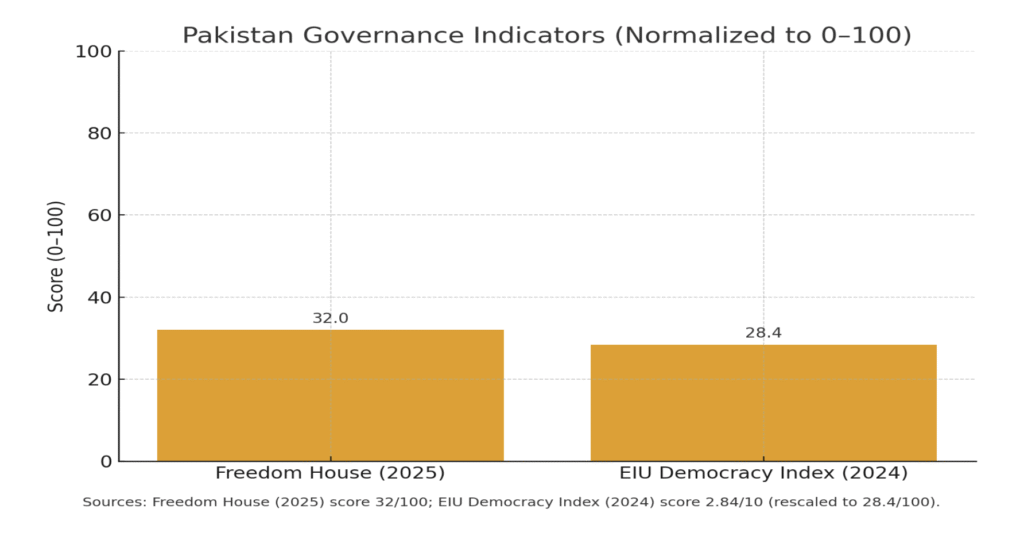
This division has been aggravated by locking up of information in the run-up and the aftermath of the election. On the day of the election, the mobile services were also halted by the authorities and twitter was also blocked on the grounds of national security.Such actions curtailed transparency when trustworthy information was the greatest requirement. The freedom of expression, assembly and non-violent demonstrations remains a restricted area and organizations such as CIVICUS still place the civic space in Pakistan as being in the repressed category. Political unity is also a problem due to the security situation since in 2024, more than 500 terrorist attacks and over 850 deaths have been reported, and political moderation is more dangerous and leadership is encouraged to respond with security in mind. This short essay holdsthat polarization has become one of the biggest threats to good governance. Through selective institutional modifications and intelligent policies, one can minimize tensions, enhance transparency and rebuild the trust of the people without compromising security.
Governance and Institutional Reform.
To begin with, there is the need to enhance electoral processes in order to have political disagreements to occur within the right systems. The Commonwealth Observer Group reported that there were issues with campaign management, sharing of election results, as well as resolution of disputes. It suggested some changes to make the Election Commission of Pakistan more independent and competent. Among the concepts to be developed is to develop the open election data system that will place detailed election data, including data at polling stations, records of sharing of results and results summary per constituency in a digital format that is readable easily. This would allow citizens, political parties, media and courts to verify the results and minimize the spread of rumors.
Having election dispute resolutions that are transparent, time-bound and provided with public status updates would also help to minimize the application of street protests as opposed to legal means. Such changes can be backed by providing the Election Commission with a greater control over the budget and open and transparent appointment procedures as a means of making sure that it can purchase technology, manage logistics, and enforce rules without any political interference.Parliaments should also be changed in order to transform competition into positive debate and supervision. To prevent destructive arguments, it is possible to develop regulations that will ensure that opposition parties are treated fairly, provide minorities with an opportunity to be heard at the floor and change the position of committee leadership. Less political and more open budget debates by a non political Parliamentary Budget Office would ensure that there is no last minute political wrangling.
There are also digital governance reforms that are important. Cessation of mobile services and blocking social media on the day of elections negatively affect the confidence and make the process more polarized since individuals are not able to check facts or read official publications. Substituting these blockades with lawful, specific, and temporary restrictions, which are justified and reasonable, as well as the written instructions and clarifications, would be in line with the rights and international practice, yet leave means of actual emergencies. An open list of governmental demands to censor material or even block platforms would also generate greater visibility and prevent the abuse of such privileges.
Risks and mitigations
One of them is that security incidents at the time of a reform window will lead to a reversion to general and indiscriminate restrictions. It can be addressed by pre-established emergency procedures that are limited, time-constrained, and self-disclosed retrospectively, legislative regulation and sunset provisions. The other danger is the risk of political defection through voluntary compacts as short term incentives to escalate re-occur. A compliance fee with the Code of Conduct to the allocation of committee chair, floor time, and public funding increases the expense of opportunism. Lastly, non-cooperation or slow reaction to government demands by platforms can harm targeted rights-respecting content control; recourse to court-reviewed orders is the sole strategy that will maintain that relationship on a lawful footing.
Policy Guidelines on Strategy.
An effective short-term measure must look at measures that are definite and measurable to minimize uncertainty among the citizens and political organizations. In elections, an open data system may be tested by the Election Commission on future elections, with detailed reports of the results, turnout and schedule being updated in real time. This is to be balanced with strict time constraints on the handling of legal complaints and tracking systems by the masses. Such measures directly respond to problems identified by the international observers and reflect a genuine desire to learn the lessons of the 2024 elections.

The government and Pakistan Telecommunication Authority needs to establish a strict order on the use of control measures on digital governance. They are first to employ specific content modifications and counter messaging, limited, court approved blocks as last resort, and fullshutdowns as a last resort with automatic termination dates and periodic reports. Any platform limitations should also be directed by clear rules, including written legal instructions, stipulated time limits, frequent independent reviews and published statistics. Such measures would decrease the distribution of conspiracy theories and decrease the reputational and economic cost of large blockages or broader upheavals. There should be building of trust among the political parties. The leaders of the parties might endorse a social Code of Democratic Conduct which consists of not inoculating violence, not distributing faked media, confessing to distorted material, and respecting the decisions of the court. To render this code realistic, they should be associated with actual rewards such as additional time in the parliament, leadership in a committee, and publicly funded.
This would provide real consequences to not adhering to the code. Also, provinces and civil society ought to invest in educating the population on the count process and resolution of votes, which is done via schools, media and the legal organizations. On the ground level, organized forums of dialogue of the party workers, youth groups and the local media might offer secure grounds upon which people can raise concerns before they escalate to conflicts. As insecurity and misinformation make polarization worse, these low cost and high visibility measures can be used to curb rumors spread and the likelihood of street fights instead of parliamentary discourse.
Therefore, there is the necessity to balance security and civil rights. The state has more than 500 attacks and 850 deaths in the year 2024 which is a huge cause of its urgency to respond swiftly. Nevertheless, well defined, regulations based emergency plans can in fact enhance popular support. Protest management, de-escalation training, and instant judicial processes of detention can help mitigate the possibility of security operations being perceived as partisan, which tends to escalate polarization. The practices should be incorporated in normal regulations and police education to ensure their sustainability in various government leaders.
Conclusion
The polarization in Pakistan is not just an issue of hyperbole, but it is a structural limit to Pakistan governance that stampses investment, stifles reform, and decays popular confidence. The facts are unmistakable: lower freedom ratings, authoritarian level democratic indicators, a blackout during election day and a blockage of the platform, and the high level of the threat situation are all the ingredients to increase the stakes of any political conflict. More plausible approaches to shaping the curve are to present verifiable changes in areas of legitimacy contention: transparent election information and time limited adjudication, due process based digital government, routineized opposition rights in parliament and focused civic education and dialogue initiatives. These steps are realistic, cheap, and can be used alongside the security requirements and with a combination of these in one step, the confidence that political conflict can be solved not on the streets, but through institutions, can be slowly rebuilt.
Author Name: SHEHARYAR KHALID