Now Reading: Policy Brief: Gender Inclusive Green Energy Transition in Rural Pakistan
-
01
Policy Brief: Gender Inclusive Green Energy Transition in Rural Pakistan
Policy Brief: Gender Inclusive Green Energy Transition in Rural Pakistan

Introduction
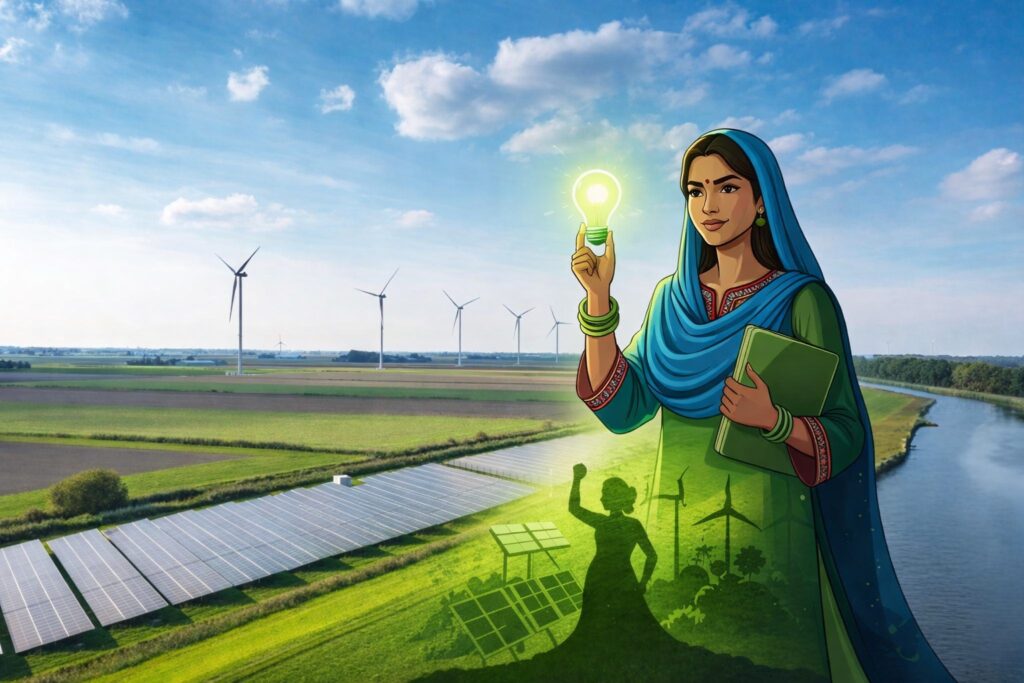
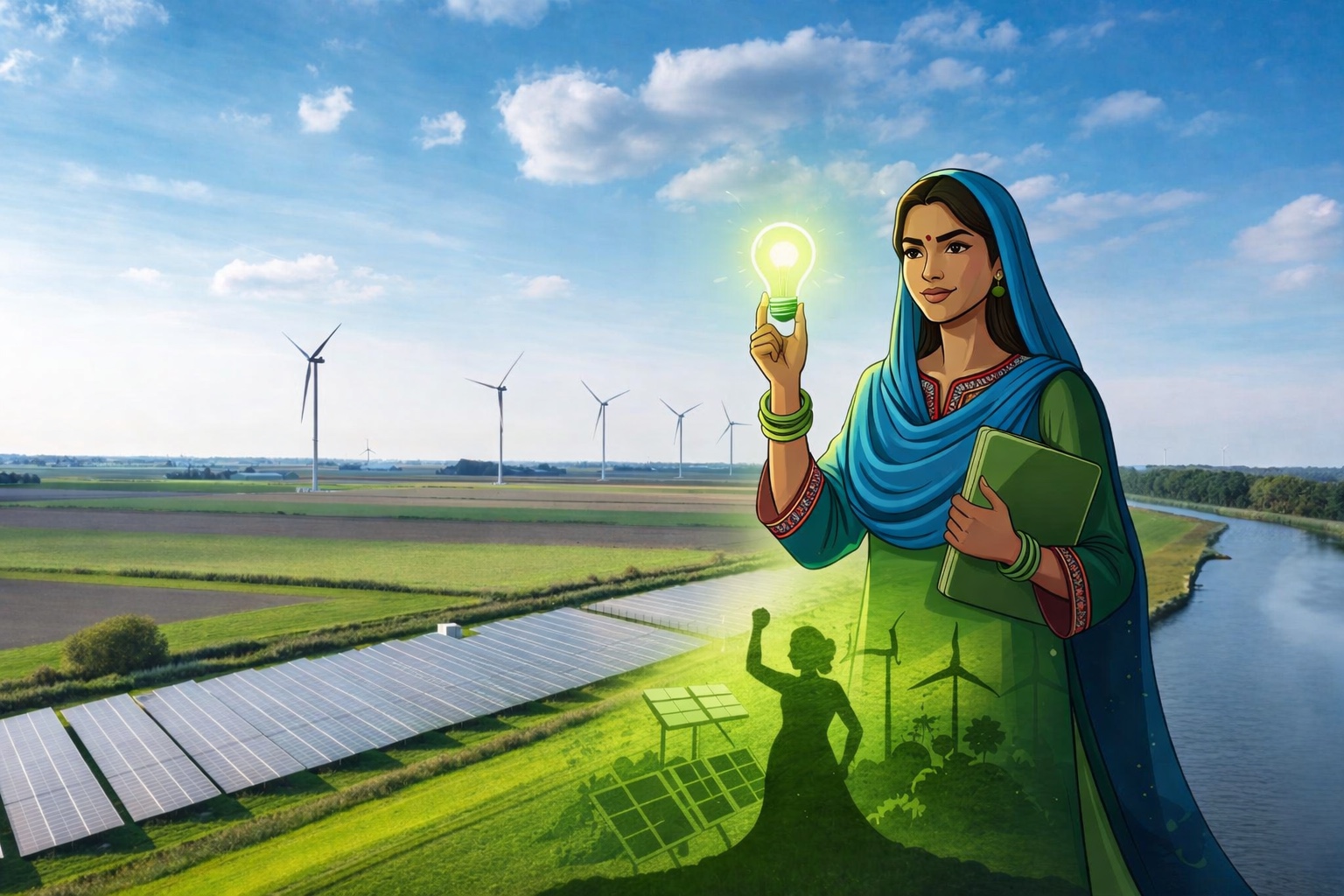
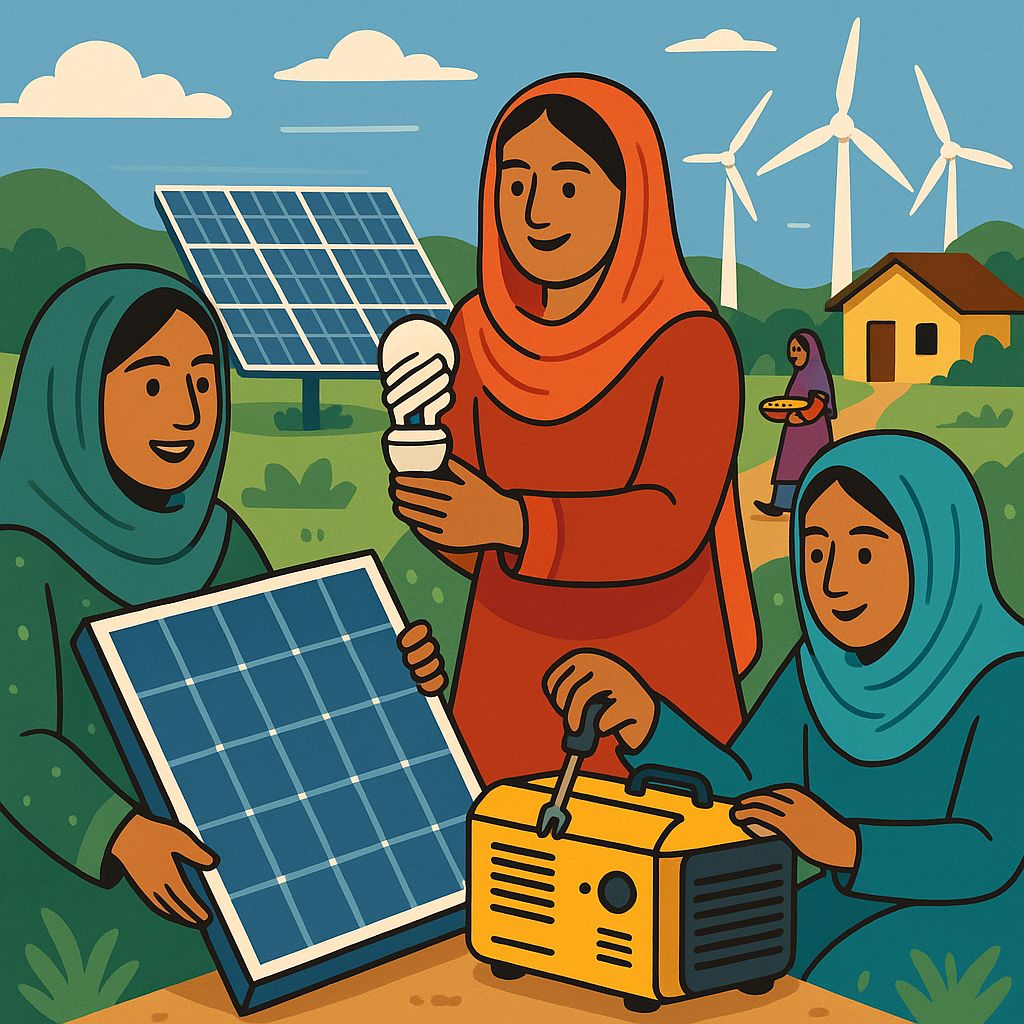
The transition to green energy in rural Pakistan is unique and presents a once in a lifetime opportunity to simultaneously tackle three big challenges faced by the country energy poverty, environmental pollution and gender discrimination. In rural areas, women are the main controllers of household energy consumption but they are underrepresented and less trained in the policy dialogue related to renewable energy. In this policy brief, we investigate how rural women in Pakistan can be positioned as key actors in the move away from traditional forms of energy (biomass, biogas) to more environmentally sustainable sources such as solar power, micro-hydro and wind technologies. Considering socio cultural barriers, capacity development needs and financial restraints and suggesting structural reforms and strategic policy directions, this policy recommendation paper provides a well paved roadmap for a gender-inclusive green energy transition that is socially transformative and economically viable within the context of Pakistan.
Background
Energy shortages in rural Pakistan remain acute with millions of households dependent onvtraditional fuels like firewood, crop residue and dung cakes. These sources contribute tovenvironmental destruction, loss of forests and long-term health hazards from indoor airvpollution. Biogas systems, although cleaner than the above cited methods, are not widespreadvand require availability of livestock; their scalability is hence uneven across regions. The burdenvof energy scarcity is greatest on women, who are disproportionately vulnerable due to the time spent gathering a fuel and directing domestic energy use. A study on the energy landscape of rural Pakistan showed that only a fraction of the homes were switching to clean cooking or green power, hence continuing to face ongoing energy poverty.
In contrast, Pakistan is endowed with immense renewable energy potential including high solar irradiance levels in the region and micro-hydropower in mountainous regions which remains largely untapped. 2.9.Non-governmentalorganizations, the United Nations agencies, and community-based organizations have shown strong evidence that women are able to carry out effective installation, maintenance and management of decentralized energy systems based on renewable sources with adequate training and a supportive environment from their communities. These effortsdemonstrate that renewable energy makes people better off, leads to entrepreneurism and enhances women’s mobility and decision-making control. Nevertheless, systemic bottlenecks such as cultural resistance, lack of finance and weak regulatory enforcement, disintegrated institutions and absence of gender-disaggregated data persist in
hampering scaling-up.
Institutional Reforms
Potent governance is also key to the success of a green transition, and Pakistan will need to implement numerous institutional reforms to bolster women’s participation in renewable energy. A Women in Renewable Energy Coordination Council or similar inter- ministerial coordination body should be created to ensure coherence among the work of the Ministries of Energy, Climate Change, Rural Development, and Women’s Development. This council would manage policy coordination, monitor progress and serve as a go-between for federal and provincial stakeholders. Provincial technical education boards should mainstream renewable energy courses, with quotas for women and scholarships, and collaborate with local NGOs to provide training in remote areas.
Better to control the renewable energy as well! National standards must also be applied for solar panels, batteries, wiring and inverters to eliminate the substandard products that undermine confidence in clean energy technologies. Local governments require empowerment for installation oversight, support to community-based energy cooperatives and orders for after sales services provision, to ensure the long-term system sustainability. Enhancement of data collection is another key institutional reform that all the projects on renewable energy need to report gender disaggregated data for better policy planning. Further, renewable energy targets could be incorporated into district level development plans to ensure that the goal of energy access aligns with local needs including women’s mobility, enterprise opportunities and household energy security.
Capital and External Support for the Green Transition
A green rural Pakistan cannot emerge in the absence of diverse and dependable sources of investment. Domestic public finance should consider renewable energy as a part of the rural-focused development framework and also allocate annual budget to womenled RE programmes. The private sector should be encouraged by tax benefits, reduction of import duties on top-end renewable energy products and public–private partnerships to increase rural electrification.
International development agencies like the World Bank, Asian Development Bank, UNDP, UNIDO and Green Climate Fund can offer grants, concessional loans and expertise to help develop capacity, infrastructure and community driven renewable energy projects. International climate finance including resources targeted at gender responsive energy access could also be used to scale implementation. Other bilateral donors with experience on women-focused energy programs in regions such as South Asia or Sub saharan Africa can provide technical training models and cross-country learning. Innovative financing solutions, such as pay as you go solar, community managed solar cooperatives, Islamic microfinance instruments and carbon-credit generation strategies, can make the technology more affordable and scalable. Such financial instruments are particularly suitable for low-income rural women who do not possess conventional security but can earn small repayments with home-based or agricultural enterprises using renewable energy.
Women as Catalysts of Sustainable Energy Solutions in Rural Pakistan
This woman led rural green energy transition in Pakistan brings substantial labour, economic climate benefits which at the same time also serve national development targets. On the employment front, the upskilling of rural women in installing solar and maintaining/operating it at a basic technical level opens new doors to work in regions where job opportunities for women are generally scarce. This also serves to decentralise the rural working group and lessen reliance on outsiders for technical support by self building local capacity. So when women are no longer working for free to collect fuel they have time to be trained and paid in technical jobs, benefiting the whole community which will see a more productive workforce that some men may resent but one of whose beneficiaries will be wives with greater economic imperative and decision-making power at home.
Financially, the use of renewable energy instead of firewood, kerosene or diesel can save households money on these recurring expenses and free up additional income for education, food security or small business growth. Reliable electricity access also fuels micro enterprise development–solar sewing work, food processing, recharge shops and farm services enhancing rural market opportunities and poverty alleviation. The very act of women engaging in renewable energy entrepreneurship has a ripple effect that results in higher household incomes, more diversified local economies and communities that are increasingly less impacted by economic shocks. Over the long term, adoption of renewables such as solar in rural areas also dovetails with national goals around reducing energy imports and encouraging local manufacturing and new value chains related to skinning this pepper.
Environmentally, the transition from biomass and kerosene to renewable energy decreases deforestation, indoor air pollution and greenhouse-gas emissions. UNDP Solar and micro hydro projects reduce dependence on the use of wood and crop residue, which contributes to restoring the local ecosystem and preserving community health, in particular that of women and children, who are most affected by smoking from using such materials. Renewable energy boosts climate resilience by decreasing reliance on rickety grid systems that all too often break down during floods, heatwaves and other extreme weather events. When women are trained in how to use and market clean energy technologies, they become advocates within their communities for the environment and efficient use of resources, increasingly contributing to long-term conservation.
Medawar’s AID funded study focuses on the broader gains of women participating in the green transition: to labour, rural life and meeting Pakistan’s climate and environmental targets, along with providing a solution for energy poverty in an environmentally respectful and socially inclusive manner.
Risks and Mitigation
The tendency to shift towards a women focused renewable energy approach is faced with risks that need careful management. In many rural areas, cultural norms prevent women from entering technical fields and confine them to the household, where their role is often limited to cooking and cleaning. Such restrictions create opposition to having women involved in installation, repair or community based energy management. To address these cultural obstacles, educational campaigns should target men, local leaders and religious elders to promote acceptance of women’s technical participation in renewable energy projects. Another important health hazard is related to the low level of literacy prevailing among rural women, which can lead to lack of comprehension towards different technical aspects. So training may need to shift to visual, hands-on training with demonstrations rather than reliance on written material.
An additional threat is market invasion by low-quality solar panels, batteries, and inverters that erode confidence in renewables and result in system failures for those who can least afford it. We also need more supervision for regulation, certification and after-sales service to avoid market abuse. The financial risks are also a hurdle for women, who more frequently experience inadequate access to formal credit and take longer than men to accrue collateral that banks are prepared to accept. This can be addressed by gender-focussed approaches to microfinance, subsidies and pay as-you-go solar systems that lessen the initial cost barrier. A further institutional risk is related to the sector governance of renewables in Pakistan, which is broken and induces implementation lags. Better cooperation between the national, provincial and district levels is needed to address bureaucratic wastage. Lastly, climate shocks such as water floods or dryspells can cause physical damage to installations or interruptions in micro-hydropower systems. Adaptation options such as climate robust design and insurance can lower exposures.
Strategic Policy Recommendations
A national renewable energy strategy with a gender focus is crucial for placing rural women at the heart of the green transition. The latter approach should start with a full acknowledgement that women are central energy stakeholders and target setting for women’s involvement in renewable energy training, enterprises, and governance. Localised renewable energy centers or academies for women: There is a need to establish in country capacities and hands on training schools focusing on RE, including modules covering installation, repairs and maintenance of various technologies as well as small business development. These centres should employ and train women teachers to remove cultural barriers, improve community acceptance and enhance role models for villages.
The government should make available financial mechanisms such as solar home system subsidies, grants to women – led renewable energy cooperatives and credit guaranteed especially for banks and micro finance institutions to provide loans to rural women without collateral. Widespread deployment of decentralized solar systems like solar micro-grids, solar-powered water pumps, solar dryers and sundry village-based cottage industries will generate income for women while also cutting down on use of diesel likewise wood and kerosene. Complementing investments in renewable energy access with agricultural mechanization is also critical; solar irrigation pumps, SME cold storage and solar driers provide significant benefits for female farmers and rural entrepreneurs.
Public awareness campaigns by local leaders, religious scholars and schools networks must make adopting renewable energy a socially acceptable and financially rewarding decision. Private sector partnerships are also critical; energy companies must be incentivized to hire and train rural women for service, instalment and domestic sale roles. A national program “Women Energy Champions” can further engage women as at-community trainers and advocates promoting the scale-up of renewable energy interventions in rural Pakistan.
Conclusion
The shift to clean energy in rural Pakistan is at the intersection of climate action, gender equality and economic resilience. The unfairly high cost of traditional energy to women can be transformed into a powerful force for the good if they are equipped with skills, capital and institutions that enable their engagement in – and leadership of — the green transformation. Illustration One lesson that can be learned from Pakistan and similar nations is simply this: When rural women are empowered with training and finance, they not only perform well in managing renewable energy systems, but also are able to put their families and communities into a better state of income generation and quality of life. A gender-sensitive approach that links the expansion of renewable energy with training, finance, institutional reform and community participation is necessary for Pakistan to balance its priorities including sustainability development and energy security. A rural energy systems-based strategy of this nature can both “leapfrog”, the transformation of rural energy end-use by gender, and support broader national priorities around climate resilience, economic development and gender equality. If it prioritizes women in the transition to renewable energy, Pakistan can grow a more inclusive, sustainable and prosperous future.